
5 grooming habits damaging hair skin
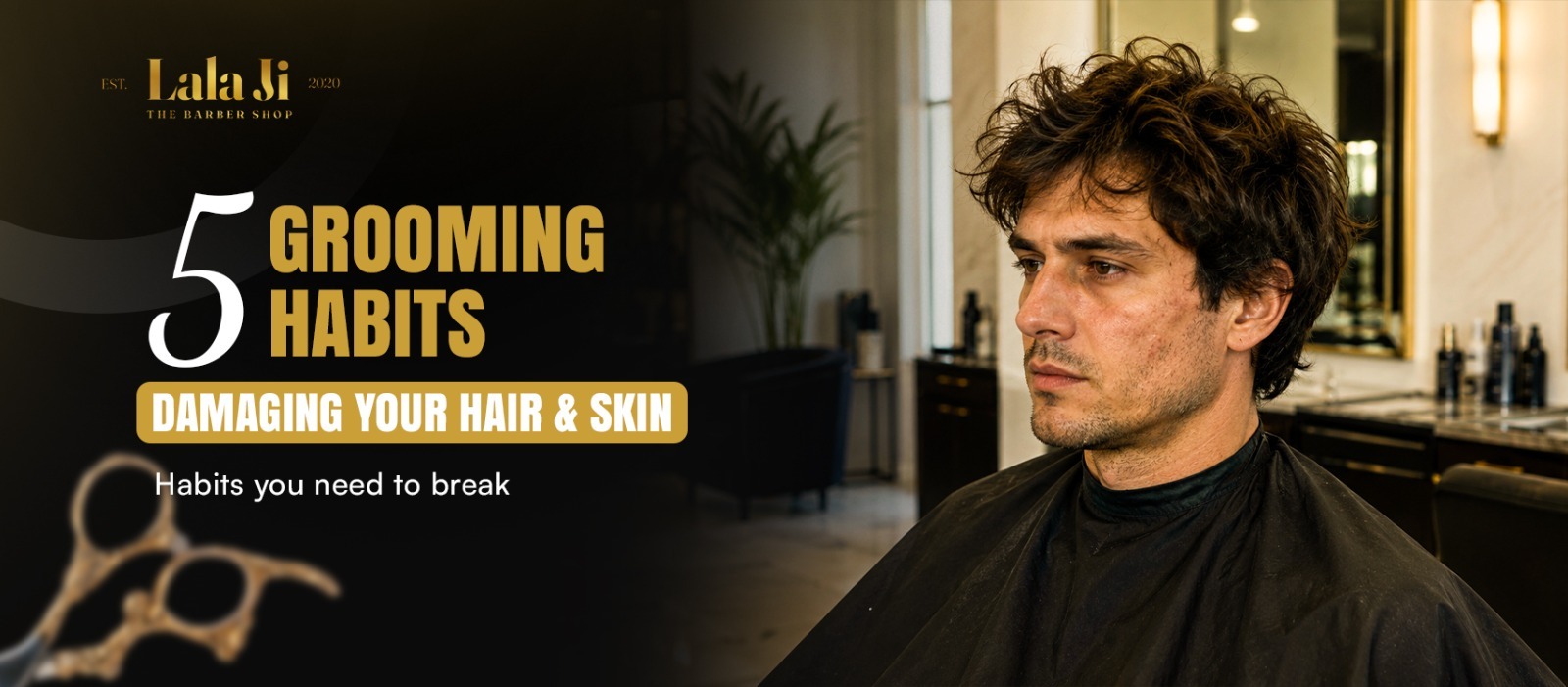
Table of Contents
You May Like This
Share It On
You’re probably doing at least two of these every single day without realising it. The good news: every single one is fixable — once you know what you’re actually doing to yourself.
Here's something no one tells you about grooming: the products you're buying probably aren't the problem. The habits you've built around them — the ones that feel normal, even responsible — are quietly doing more damage than any cheap shampoo ever could. This is the report your mirror has been trying to file for years.
We see the evidence in the chair every single day at Lalaji The Barbershop — across our seven Nova Scotia locations. Dry, brittle hair snapping at the ends. Flaky, irritated scalps that no dandruff shampoo has been able to fix. Skin that looks dull despite a solid skincare routine. And almost every time, when we ask about the daily routine, at least one of these five habits is somewhere in it.
The frustrating thing about sneaky habits is that they feel right. Scrubbing your scalp hard feels thorough. Hot showers feel restorative. Towelling off fast feels efficient. None of those feelings are wrong — but the biology underneath them is telling a different story. Let’s read that story properly.
- Damage
The most comfortable habit. The most damaging to your scalp.
- What You're Doing
Standing under water as hot as you can tolerate, letting it run over your scalp and face for 10–15 minutes. It feels like it’s cleaning deeply. It feels like it’s relaxing your muscles and opening your pores. It feels like self-care.
- What It's Actually Doing
Stripping the sebum — your scalp’s natural protective oil — far faster than your body can replace it. Hot water dissolves the lipid barrier on your skin and scalp, leaving both exposed and dehydrated. Your scalp responds by overproducing oil to compensate, which can lead to greasiness, irritation, and accelerated flaking.
Your scalp is skin — just skin that happens to grow hair from it. It has the same needs as the skin on your face: a balanced moisture level, an intact protective barrier, and a stable pH. Water above roughly 38°C (100°F) begins actively dismantling all three of those things.
The Biology
The stratum corneum — the outermost layer of your skin — is held together by lipid molecules that act like mortar between bricks. Hot water dissolves these lipids selectively, creating microscopic gaps in the barrier. Transepidermal water loss then accelerates through those gaps, leaving the skin and scalp chronically dehydrated regardless of how much moisturiser you apply afterward.
This is also why your face often looks slightly red and feels tight immediately after a hot shower — you’ve temporarily disrupted the vascular and barrier functions of the skin. Over time, chronic hot showering contributes to increased skin sensitivity, accelerated signs of aging from dehydration, and a persistently irritated scalp that no shampoo seems able to fix.
- The Fix — Shower Smarter, Not Colder
You don't need an ice shower. Drop the temperature to warm rather than hot — specifically when you're washing your hair and face. The simple rule: if it looks like steam is rising off your skin, it's too hot. End every shower with 20–30 seconds of cool water on your scalp and face. This closes the cuticle, reduces redness, and contracts the pores after cleansing. Your scalp will regulate oil production better within two weeks of consistent temperature reduction.
- Damage
Washing Your Hair Every Single Day
- What You're Doing
Shampooing daily because hair that’s been exercised in, slept on, or exposed to the environment feels dirty. You might also just like the way freshly washed hair looks and behaves. Both completely reasonable — except for what’s happening underneath.
- What It's Actually Doing
Training your scalp to overproduce sebum by constantly stripping it. The more frequently you remove the scalp’s oil, the faster the sebaceous glands produce to replace it — creating a cycle where your hair gets greasy faster and faster, which makes you feel like you need to wash it more, which makes it worse.
Most shampoos — particularly anything marketed as “deep cleansing” or “purifying” — contain surfactants designed to strip oil. Used daily, they’re removing oil your scalp actually needs. Sebum is not a problem to be solved. It’s a conditioner your body produces for free. It lubricates the hair shaft, protects the scalp’s barrier, and keeps the hair flexible rather than brittle.
What Dermatologists Actually Recommend
For most men, washing hair every 2–3 days is optimal for scalp health. Men with coarser, curlier, or thicker hair types often benefit from washing even less frequently — as little as once per week — because their hair structure makes it harder for sebum to travel down the shaft naturally, making the scalp more prone to dryness. The right frequency is the one where your scalp stops overcompensating.
The “adjustment period” when you reduce washing frequency is real — the scalp takes 2–4 weeks to recalibrate oil production after years of daily stripping. During that time, dry shampoo and rinsing with water only (no shampoo) are your tools. Push through it. The scalp on the other side is noticeably healthier.
- The Fix — Train Your Scalp Down
Don't go cold turkey from daily washing — step down gradually. If you currently wash every day, try every other day for three weeks, then every two days. Use a sulphate-free shampoo: it cleanses without the aggressive oil-stripping of sodium lauryl sulphate, which gives your scalp's barrier a chance to stay intact between washes. On non-wash days, a water-only rinse removes sweat and surface debris without touching the oil balance.
When you do shampoo, focus the product on the scalp — not the lengths. The lengths get cleaned from the runoff. Massaging the scalp during shampooing also stimulates blood circulation to the follicles, which supports healthy hair growth directly — making wash day a net positive rather than just necessary damage control.
- Damage
Aggressively Towel-Drying Your Hair
- What You're Doing
Grabbing a towel and rubbing your hair vigorously — back and forth, friction-first, drying as fast as possible because you have somewhere to be. Maybe wrapping it tight and leaving it coiled under tension while you do other things. Fast. Efficient. Completely mechanical.
- What It's Actually Doing
Wet hair is at its most structurally vulnerable state. The hydrogen bonds in the hair shaft — which normally give it elasticity — are broken by water, making the shaft up to 70% weaker than when dry. Aggressive friction snaps the cuticle layer, creates frizz, causes split ends from mid-shaft, and breaks entire strands that would have grown perfectly fine if you’d just been gentler for 30 seconds.
The terry cloth weave of a standard towel is effectively sandpaper at the microscopic level when dragged against a wet hair shaft. Every aggressive pass lifts and chips the cuticle — the protective outer layer of the hair strand — creating rough, porous surfaces that tangle, frizz, and break more easily going forward. It’s compounding damage that accumulates with every wash.
The Trichology Perspective
Hair trichologists — specialists in scalp and hair health — consistently identify mechanical damage from towel drying as one of the most common but most correctable causes of hair breakage. The damage is most visible at the lengths and ends (what appears as "split ends") but the force is generated at the scalp level where the hair emerges. Reducing towel friction is one of the highest-return grooming changes most men can make with zero cost.
- The Fix — Squeeze, Don't Scrub
Don't go cold turkey from daily washing — step down gradually. If you currently wash every day, try every other day for three weeks, then every two days. Use a sulphate-free shampoo: it cleanses without the aggressive oil-stripping of sodium lauryl sulphate, which gives your scalp's barrier a chance to stay intact between washes. On non-wash days, a water-only rinse removes sweat and surface debris without touching the oil balance.
If you use a blow-dryer, keep it moving — never hold it stationary on one section — and use the lowest heat setting that still dries effectively. A diffuser attachment on medium-length or longer hair reduces the concentrated heat and the force of the airflow. Leave the hair 80% dry and let the remaining moisture evaporate naturally rather than chasing zero-moisture with maximum heat.
- Damage
Using Too Much Styling Product, Too Often
- What You're Doing
Working a generous amount of pomade, wax, or gel into your hair daily — sometimes adding more mid-day to refresh the hold — and then washing it out (or not fully washing it out) in the evening. Possibly the same oil-based product every day for years. It smells good. Your hair looks good. The scalp, however, is quietly filing a complaint.
- What It's Actually Doing
Building up a film over the scalp that clogs follicle openings, traps dead skin cells, and creates an environment where the scalp’s microbiome — the balance of bacteria and fungi that keeps it healthy — is disrupted. Oil-based products in particular don’t dissolve easily with regular shampoo, meaning layers of product accumulate on the scalp over weeks of daily use.
The follicle opening — the pore your hair grows through — needs to breathe. Chronic product buildup around follicle openings creates a condition called follicular hyperkeratosis: the buildup of dead skin cells and product residue around the follicle mouth that restricts healthy growth and, in some cases, contributes to thinning in men already predisposed to it.
You can feel buildup when it’s significant — the scalp has a waxy, heavy feeling even immediately after washing. What’s often diagnosed as “dandruff” is in many cases product buildup flaking off, not a scalp condition at all.
Oil-Based vs. Water-Based Products
Oil-based pomades (petroleum jelly base, lanolin, mineral oil) require a detergent shampoo to remove and can't be washed out with water-based or sulphate-free shampoos alone. Used daily, they compound buildup rapidly. Water-based pomades wash out cleanly with warm water and are dramatically better for daily users. If you're a daily product user and currently using oil-based products, this single switch is probably the highest-value change in your grooming routine.
- The Fix — Less Product, Right Product, Proper Removal
Use a fingernail-sized amount of product as your starting point — you can always add, never subtract. Keep product off the scalp itself and apply it through the mid-lengths and ends. For daily users, switch to a water-based product that rinses clean. Once a week, use a clarifying shampoo (higher surfactant concentration than your regular shampoo) to deep-clean any accumulated buildup. You don't need it more than weekly — used too frequently, clarifying shampoos strip beneficial oils — but used weekly they maintain a clean scalp baseline that regular shampoo can't fully achieve.
Give your scalp at least one completely product-free day per week. On rest days, the follicles breathe. The microbiome rebalances. The scalp's own oil distribution normalises. It's a one-day intervention that your hair will show the results of over months.
- Damage
Treating Your Scalp Like It Doesn’t Exist
- What You're Doing
Washing your hair (the strands) and completely ignoring the scalp (the skin). No exfoliation. No massage. No moisture. No attention whatsoever, except when something goes visibly wrong — itching, flaking, irritation — at which point you buy the strongest medicated shampoo you can find and hope the problem disappears.
- What It's Actually Doing
Allowing dead skin cell buildup to accumulate without removal, reducing blood circulation to follicles through chronic non-stimulation, and missing the single most effective intervention available for hair growth support — regular scalp massage, which has peer-reviewed evidence behind it and costs exactly nothing to implement.
The scalp is the foundation of everything growing out of it. Poor scalp circulation means less nutrient delivery to follicles. Poor scalp exfoliation means buildup at the follicle mouth. Poor scalp moisture management means a disrupted barrier that overreacts to every product, temperature change, and environmental stressor. If your hair isn’t thriving, look at the ground first.
The Evidence on Scalp Massage
A 2016 study published in ePlasty found that standardised scalp massage performed for 4 minutes daily over 24 weeks produced measurable increases in hair thickness — not just growth rate — in male participants. The mechanism is increased blood flow to the dermal papilla cells at the follicle base, which directly influences the hair growth cycle. Four minutes a day. No product. No cost. Meaningful outcome over time.
The scalp also benefits from gentle weekly exfoliation — a scalp scrub or even a soft-bristle brush worked across the scalp before shampooing removes the dead skin buildup that your shampoo alone doesn’t address. Flaking that seems like dandruff very often resolves completely with consistent exfoliation and proper moisture balance, without any medicated shampoo required.
- The Fix — Four Minutes a Day, Once a Week Exfoliation
Build a two-part scalp routine. Daily: spend 3–4 minutes massaging your scalp with firm circular motions using your fingertips — not your nails — either during your shower or on dry hair as a standalone practice. Work across the entire scalp systematically: front hairline, temples, crown, back. This is your most effective and most free grooming upgrade.
Weekly: use a scalp scrub or soft scalp brush before shampooing to physically lift dead skin cells. Apply a lightweight scalp serum or oil (jojoba or argan are closest to the scalp's natural sebum composition) to any areas that feel consistently dry or tight. Your scalp isn't your hair's inconvenient root — it's the entire reason your hair exists. Treat it accordingly, and book in regularly at Lalaji for the professional scalp treatments and hot towel services that your at-home routine can't replicate.
- Damage
01
02
03
04
05
Great grooming isn’t about buying better products. It’s about stopping the things that are quietly undoing whatever the products are trying to achieve.
The Lalaji Standard · Nova Scotia
Lalaji The Barbershop · Where the Fixes Happen in Person
Some Damage Needs a Professional.
That’s What We’re Here For.
Adjusting your shower temperature and switching to a microfibre towel will get you most of the way. But if your scalp is chronically irritated, your hair has been breaking for months, or you’ve been battling flaking that no shampoo can shift — that’s a conversation that belongs in a barber’s chair, not a bathroom mirror.
At Lalaji The Barbershop, we don’t just cut and leave. Our barbers read what they see — scalp condition, hair texture and quality, signs of damage at the ends and shaft — and give you the honest assessment your routine has been missing. Paired with our professional services, the results of fixing even two or three of these habits become visible within weeks:
Seven locations across Nova Scotia mean there’s a Lalaji chair close to wherever you are. Find your nearest location, book your next visit online, and come in ready to talk about what’s actually happening with your hair — not just what product to put on it.
Services
Booking
Our Barbers
Locations
Lalaji The Barbershop · Nova Scotia
You Know the Habits. Now Break Them.
Five changes. Some take 30 seconds. One takes 4 minutes a day. All of them are reversing damage you’ve been doing for years. And when you’re ready for the professional chapter — we’re here.
What are you waiting for? Come to Lalaji The Barber Shop
Reserve your seat and walk out looking your best.
Our Locations
Halifax
1333 South Park St, Halifax, NS B3K 2K9, Canada
Dartmouth
169 Main St Unit 05, Dartmouth, NS B2X 1S1, Canada
Truro
523 Prince St Unit 1, Truro, NS B2N 1E8, Canada
Sydney
48 Prince St, Sydney, NS B1P 5J7
Bedford
1509 Bedford Hwy, Bedford, NS B4A 1E3, Canada
Sydney Rivers
1290 Kings Rd, Sydney River, NS B1S 1E1, Canada
Barrington Street, Halifax
1065 B Barrington St, Halifax, NS B3H 0B7, Canada
Coming Soon! More Locations
Launching soon stay tuned for updates!