
The History of the World Cup’s Most Legendary Hairstyles
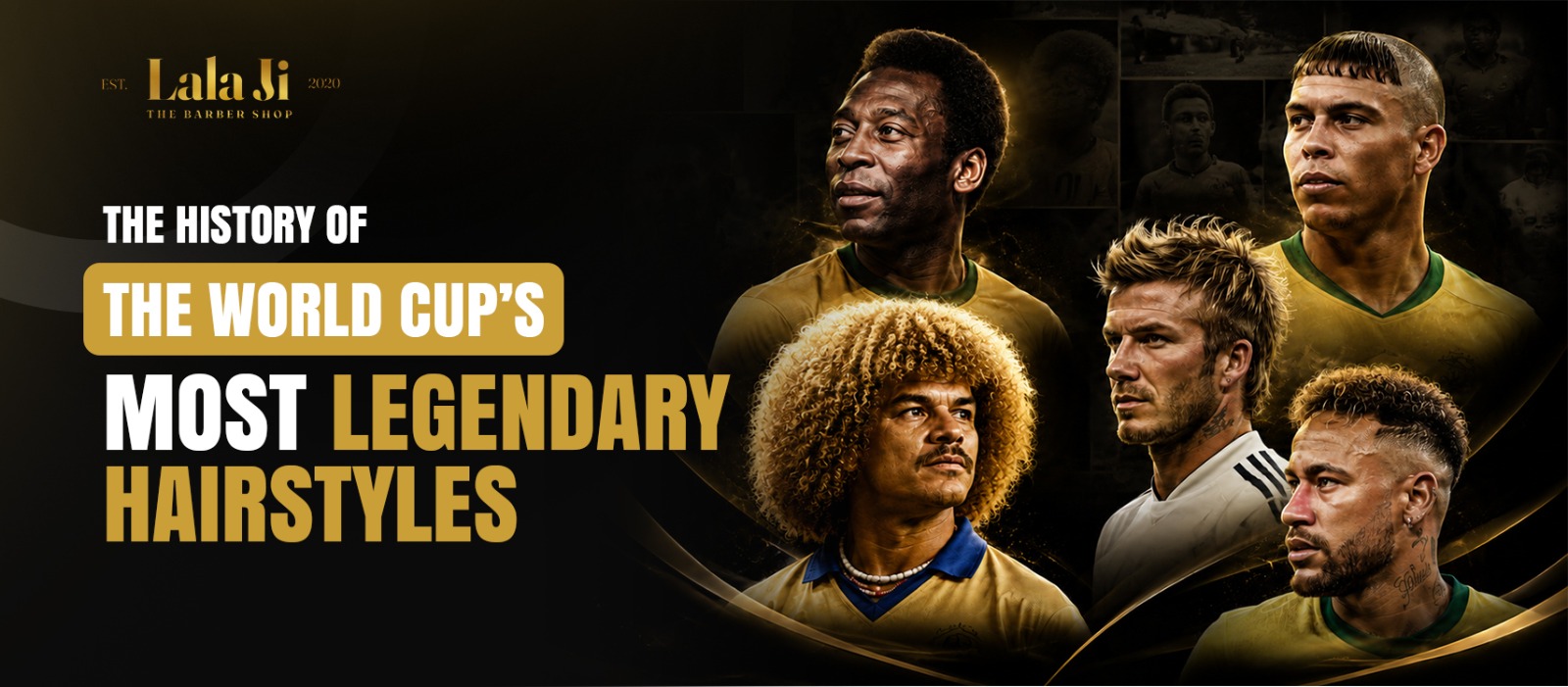
Table of Contents
You May Like This
Share It On
Every four years, the world stops. Not just for the goals, the upsets, and the last-minute penalties that send entire cities into collective breakdown — but for the hair. The beautiful game has always had a beautiful relationship with grooming, and no stage in sport produces more iconic hairstyles than the FIFA World Cup.
Think about it. Billions of eyes, every match broadcast to every corner of the planet, and cameras that don’t miss a thing. The World Cup is the greatest free advertisement a hairstyle has ever received. When a player scores in the 90th minute and rips off his shirt in celebration, the world doesn’t just see the goal — it sees the cut, the fade, the texture, the way his hair holds under the pressure of a hundred-metre sprint.
At Lalaji The Barbershop, football is a second language. Our chairs across Nova Scotia have seen every version of the post-World Cup hair request: the guy who walked in with a photo of Beckham in 2002, the one who wanted Ronaldo’s fringe (yes, really), the one who still swears Valderrama’s afro was the peak of human achievement. We love them all.
So as the world gears up for the 2026 World Cup on North American soil, we’re doing what barbers do best — sitting back, telling stories, and tracing the cuts that changed everything.
Football gave hairstyling its greatest advertising budget in history — billions of viewers, zero cost, and the most photogenic men on earth doing the modelling.
The Lalaji Take
1930
5B+
7
Chapter One
The Golden Age — 1950s–1970s
Before we get to the cuts everyone knows, let’s start where the story really begins — in the slicked, brilliantined, side-parted era of World Cups past. The 1950s and 60s were a different world. Players didn’t have nutritionists or sports psychologists. They had a comb, a tin of pomade, and dignity. The side part was king. Whether it was Brazil’s Pelé or West Germany’s Gerd Müller, the look was the same: neat, deliberate, and entirely impractical for 90 minutes of professional football.
But here’s what those barbers understood that we sometimes forget: structure signals authority. The cleanly pressed, squared-off cut of that era said something. It said these men were prepared. Disciplined. It was the haircut equivalent of a firm handshake.
1972
Pelé and the Afro's First World Cup Moment
The cut that quietly changed everything
By Mexico 1970, something was shifting. The side parts were loosening. Pelé — the greatest footballer who has ever lived, and don’t argue with us — wore a short but natural Afro that moved when he moved. It wasn’t styled into submission. It existed on its own terms, and in the context of world sport, that was quietly revolutionary.
The 1970 World Cup was the first to be broadcast in colour globally. For the first time, the world saw exactly how these players looked — skin, hair, expression, and all. Pelé’s natural texture, worn without apology on the biggest stage in sport, planted a seed. It would bloom dramatically just two decades later under Colombian skies.
1994
Carlos Valderrama & The Greatest Afro in Football History
The cut that made a man into a national monument
No list of World Cup hairstyles begins anywhere other than here. Carlos Valderrama — El Pibe, The Kid — arrived at USA ’94 with a mane so extraordinary, so perfectly improbable, that it stopped being a hairstyle and became a landmark. The Colombian captain’s massive, golden-tinted, perfectly spherical afro was so large, so magnificent, that Adidas reportedly used its shape in one of their World Cup promotional campaigns.
Valderrama didn’t style his hair for the World Cup. He didn’t have a barber fly in. His hair was his hair — enormous, proud, and entirely indifferent to the laws of aerodynamics. Watching him play was watching a human comet streak across a pitch. The ball moved. Valderrama’s hair moved with it.
What made it legendary wasn’t just the size — it was the consistency. That afro looked exactly the same in the pouring rain as it did in the blazing American summer heat. There’s a lesson in that for every man who has ever complained that his hair “doesn’t hold.” Valderrama’s hair held. Valderrama’s hair always held.
The Modern Valderrama at Lalaji
The volume and texture at the heart of Valderrama’s look has evolved into today’s most requested curly and Afro texture cuts — shaped fades beneath natural curl volume, tapered at the sides to let the top breathe. If your hair has natural curl pattern or coil, this is a lineage worth claiming. Our barbers at every Lalaji location specialise in natural texture management and curl-specific cutting techniques that honour the hair’s actual shape rather than fighting it.
1998
Ronaldo's Phenomenon Cut & The Birth of the Statement Bleach
The Brazilian superstar who made hairdressers out of everyone
Brazil’s Ronaldo — not Cristiano, the original, R9 — arrived at France 1998 as the best player on the planet. He was 21. He had cheekbones that belonged in a Renaissance painting and a bleached, platinum-streaked cut that had half the boys in Europe asking their mothers if they could dye their hair. The Brazilian squad as a whole had embraced bleaching in 1998, but Ronaldo made it look like art.
The look was a tapered cut with platinum blonde sections worked through the natural dark hair — high contrast, youthful, entirely of its era. In the summer of 1998, every youth football academy in the world became briefly a bleach bottle. It was chaotic, beautiful, and slightly dangerous to recreate without professional guidance.
The modern evolution of this look is the two-tone fade — natural dark hair at the roots transitioning into a lighter tone at the tips, finished with a skin fade at the sides. Subtle where Ronaldo’s was bold, but carrying the same energy. You can ask the team at Lalaji about colour work integrated with your cut — we’ll advise on what works for your skin tone and natural colour before a single drop of developer touches your head.
2002
Ronaldo's Fringe — The Cut That Broke the World
A shaved head with a triangle. The world lost its mind.
We have to talk about it. There’s no version of this article that doesn’t talk about it. At the 2002 World Cup in Japan and South Korea, Ronaldo — again R9, the original — arrived with a look that has haunted barbers and delighted internet archivists ever since: a completely shaved head except for a small triangular fringe of hair above the forehead. It was baffling. It was inexplicable. It was, according to Ronaldo himself in a later interview, done partly to make his son laugh, and partly because he wanted to make the headlines.
It worked. The cut reportedly became so famous during the tournament that parents across Brazil struggled to get their children to school on time because every boy wanted the same look and queues outside barbershops stretched around the block. Barbershops in Brazil reported a surge in “Ronaldo fringes” that lasted through the summer. Ronaldo scored eight goals and won the tournament. The hair was undefeated.
The modern descendant of this look is more dignified — the bald fade with a hard part or disconnected element at the crown. It retains the boldness, the statement energy, the willingness to do something different, without the sheer bewilderment factor. It’s a look our barbers at Lalaji locations across Nova Scotia execute regularly. We won’t give you the triangle. But we will give you that same feeling of walking out of the chair having done something memorable.
Ronaldo's 2002 fringe is the most important haircut in World Cup history. Not because it was beautiful — but because it proved the whole world was watching.
The Lalaji Take · 2025
2006
David Beckham's Fauxhawk — The Cut That Defined a Generation
When football and pop culture became the same thing
By 2006, David Beckham was no longer just a footballer. He was a brand, a tabloid story, a perfume, a pop culture phenomenon. He was also the most influential male grooming figure of his generation — and his fauxhawk at the 2006 Germany World Cup crystallised that perfectly. Longer hair swept and styled upward into a loose central ridge, high skin fade on the sides, and a finish that said “I spent twenty minutes on this but I’ll never admit it” — the fauxhawk became the defining haircut of the mid-2000s.
The Beckham fauxhawk was never just about hair. It was about the idea that a man could care about how he looked and still be taken seriously. He was playing in a World Cup. He was also clearly visiting a very good barber on a very regular schedule. The message received by a generation of men was clear: grooming isn’t vanity. Grooming is self-respect.
The 2025 evolution of the fauxhawk is the textured crop with a skin fade — the central volume is lower, less theatrical, more wearable day-to-day. The fade is tighter. The product is lighter. But the spirit is identical: deliberate, structured, and unmistakably considered. It’s among the most requested cuts at Lalaji, and for good reason. It suits most face shapes, grows out gracefully, and photographs beautifully.
2014
Neymar, Özil, and the Era of the High Skin Fade
The cut that made barbers essential, not optional
Brazil 2014 was the tournament where the high skin fade became the dominant language of men’s grooming at the highest level. Neymar’s series of evolving looks throughout the tournament — bleached tips, then undercut, then braided sections — were photographed and dissected by every football and grooming publication on earth. Germany’s Mesut Özil wore a clean high fade with slicked-back top that has barely aged a day. Portugal’s entire squad looked like they’d had a collective appointment with the same exceptional barber the night before every match.
The high skin fade — where the hair is taken down to the skin (zero guard) at the sides and back, then blended upward through increasingly longer lengths — became the universal shorthand for “I take myself seriously.” It worked for straight hair. It worked for waves. It worked for coils. It was the most democratic precision cut ever to emerge from the beautiful game.
At Lalaji, the high skin fade remains our most requested technical cut across all seven Nova Scotia locations. It’s also the cut that most separates a skilled barber from a mediocre one — the blend from zero to length must be seamless, curved to the head’s contour, and executed with the right set of tools in the right order. Our barbers work with it every single day. They do it well
2022
The Modern Era — Textured Crops, Curtains, and the Return of Length
When the fade stepped back and texture stepped forward
Qatar 2022 was a different kind of World Cup — not just in terms of timing and location, but in terms of what it said about men’s grooming. The hyper-shaved, ultra-precise high fade of 2014 gave way to something more layered, more textured, more relaxed. England’s squad popularised the modern curtain — a centre-parted, face-framing medium-length style that nodded to the 90s without being nostalgic about it. France’s Kylian Mbappé wore a short, tight natural coil that required zero product and infinite confidence. Morocco’s squad, who captivated the world on their historic run to the semi-finals, wore everything from traditional short fades to full natural textures with pride.
The message of 2022 was plurality. There was no single “right” haircut anymore. The era of the monoculture fade was over. What replaced it was a more honest relationship with texture — cuts that worked with the hair rather than imposing a template on it. It’s the direction that great barbershops have been pointing for years.
At Lalaji, this is the conversation we’ve always wanted to have with every client: what does your hair actually do, and how do we make that the best version of itself? Not what’s on trend. Not what a footballer wore last week. What’s yours.
Then & Now
How the Legends Evolved — Pitch to Chair
Here’s how those iconic World Cup looks have been translated — by skilled barbers, for real clients — into the modern cuts sitting in salons and barbershop menus today:
Valderrama’s Giant Afro
All-natural volume, zero fade, hair as geography
Natural curl volume retained, tapered low fade defines the silhouette cleanly
Shaved head, single geometric detail, pure provocation
Skin fade with a razor-cut hard part or subtle geometric line in the fade
Theatrical central ridge, dramatic skin fade, product-heavy
Lower central texture, mid fade, matte product — all the confidence, half the theatre
Zero at the sides, sharp blend, impeccable line-up
The skin fade refined — curved and contoured to the individual head shape
Looking Forward
2026 — Your World Cup Moment
The 2026 FIFA World Cup arrives in North America — across the United States, Canada, and Mexico — and the eyes of the world will once again be watching. Not just the football. The hair.
This is the closest a World Cup has come to Canadian soil in the modern era. Matches will be played in cities like Toronto, Vancouver, and across the border in New York, Boston, and Seattle. The energy will be unlike anything North America has hosted in decades, and the culture that surrounds it — including the grooming culture — will be at its peak.
There’s never been a better moment to sit down, have the honest conversation your hair has been waiting for, and walk out with a cut that carries that energy through the summer. Whether you’re watching in a viewing party, hosting friends, or just want to feel sharp for what promises to be an extraordinary few weeks of football, the chair at Lalaji The Barbershop is the right place to start.
The best hairstyle is never the one you copy from a footballer. It's the one your barber helped you discover was yours all along.
Lalaji The Barbershop · Nova Scotia
More from Lalaji
More from Lalaji
Find the Right Cut for You
Skin fades, scissor cuts, beard shaping, hot towel shaves — see the full Lalaji menu across all locations.
Seven Shops Across Nova Scotia
From Sydney River to Halifax Barrington Street — find your closest Lalaji barbershop.
Meet the Team Behind the Cuts
Skill, precision, and a deep respect for great grooming — get to know the hands doing the work.
Reserve Your Chair Online
Skip the wait. Book your appointment at your preferred Lalaji location and walk in ready.
History Was Made on the Pitch.
History Was Made on the Pitch. Yours Gets Made in the Chair.
Seven locations across Nova Scotia. One standard of precision. Walk in with a vibe — walk out with a cut worth remembering.
What are you waiting for? Come to Lalaji The Barber Shop
Reserve your seat and walk out looking your best.
Our Locations
Halifax
1333 South Park St, Halifax, NS B3K 2K9, Canada
Dartmouth
169 Main St Unit 05, Dartmouth, NS B2X 1S1, Canada
Truro
523 Prince St Unit 1, Truro, NS B2N 1E8, Canada
Sydney
48 Prince St, Sydney, NS B1P 5J7
Bedford
1509 Bedford Hwy, Bedford, NS B4A 1E3, Canada
Sydney Rivers
1290 Kings Rd, Sydney River, NS B1S 1E1, Canada
Barrington Street, Halifax
1065 B Barrington St, Halifax, NS B3H 0B7, Canada
Coming Soon! More Locations
Launching soon stay tuned for updates!