You May Like This
Share It On
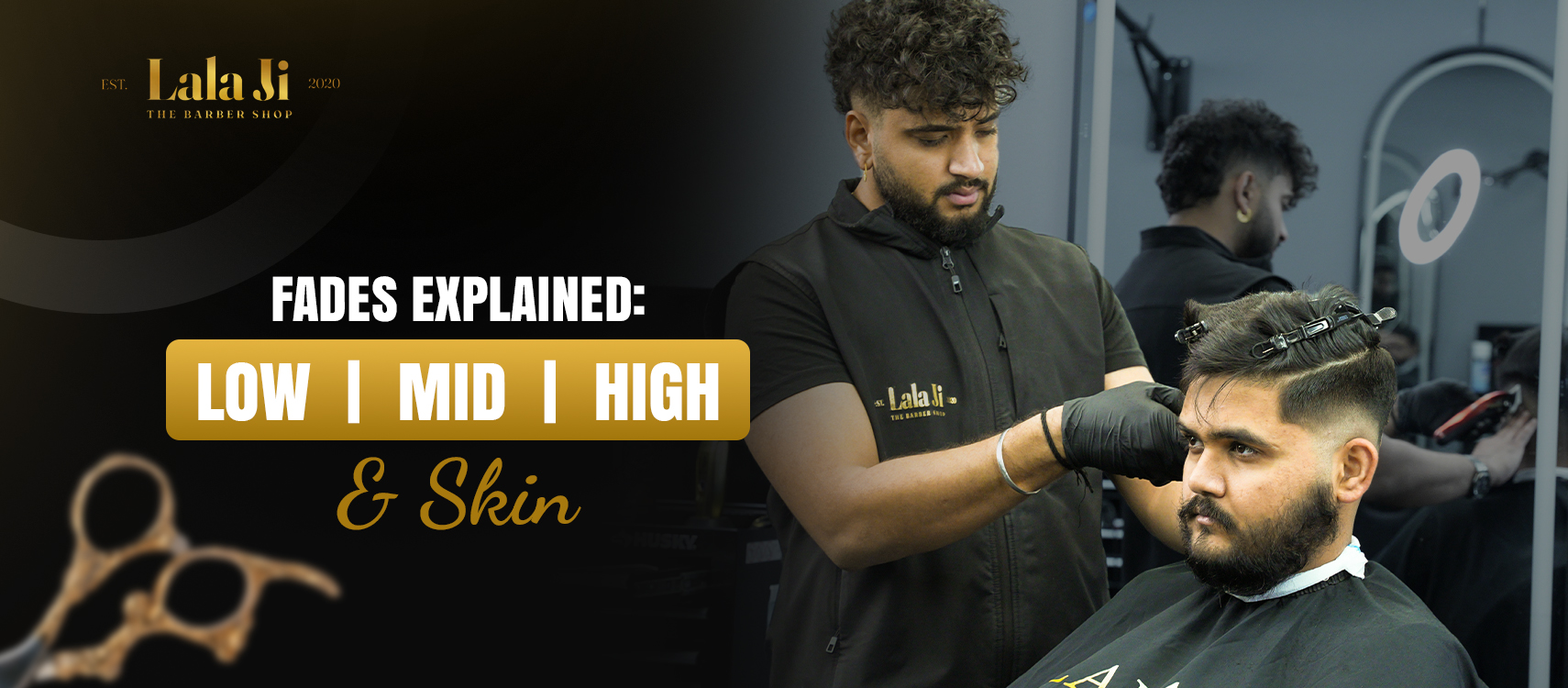
Just give me a fade” is how half of all bad haircuts start. Here’s exactly where the blend begins on your head — so you and your barber are looking at the same picture
Every barber has heard it: a client sits down, says “fade it,” and twenty minutes later is quietly panicking in the mirror because “fade” meant something different to each of them.
The good news is that fade terminology isn’t complicated once you understand the one rule behind it: every fade is defined by where the blend starts on the head. Low, mid, and high aren’t styles — they’re starting points. Once you know where that line sits on your own head, you can point to it, name it, and walk out with the cut you actually pictured.
Same head, three different starting points. This is the only diagram you need before your next appointment.
Blend starts well above the temple, near the top sides of the head. Maximum contrast, minimum length.
Blend starts roughly at temple level — the halfway point between your ear and the crown.
Blend starts just above the ear, close to the natural hairline. Subtle, keeps more length up top.
The blend begins just above the ear and the nape of the neck, leaving the rest of the sides and back close to the same length as the top. It’s the most understated fade — from a few feet away, people may not even register that you have one.
It plays well with thicker hair, keeps a professional silhouette, and is the easiest fade to grow out gracefully between cuts.
Best for: office settings, first-time fade clients, longer top styles
Starting around the temple, the mid fade sits right in the middle — enough contrast to look sharp and intentional, without the boldness of a high fade. It’s the safest “just trust your barber” request, because it flatters nearly every face shape.
Ask for this if you want a fade that reads as a real haircut, not just a trim, but still want room to grow it out before your next visit.
Best for: pompadours, textured crops, quiffs, most face shapes
The blend begins high on the sides, well above the temple, sometimes right at the parietal ridge. It exposes the most scalp and creates the sharpest line between the short sides and the length on top.
This is the fade to ask for if the top is doing the talking — disconnected quiffs, spikes, faux hawks, and slicked-back styles all lean on a high fade for contrast.
Best for: bold styling, disconnected tops, statement haircuts
Here’s the detail that trips most clients up: “skin” isn’t a fourth starting point — it’s how far down the fade goes. A skin fade blends all the way to bare skin instead of stopping at a short guard length, and it can be paired with a low, mid, or high starting point.
That’s why you’ll hear barbers say things like “high skin fade” or “low fade, but not to the skin” — they’re answering two separate questions: where does it start, and how far does it go. A skin fade gives the sharpest possible line and the most striking contrast, but it also grows out fastest visually, so it needs more frequent touch-ups.
Best for: maximum contrast, clean-cut looks, shorter maintenance cycles

Combine a starting point with a finish, and your barber knows exactly what you mean before the clippers turn on.
Now that you can name exactly what you want, let’s cut it right the first time. Book your next fade with us and point to the map if you need to.
More cuts, more guides, more good hair days at www.lalajithebarbershop.ca
What are you waiting for? Come to Lalaji The Barber Shop
Reserve your seat and walk out looking your best.
1333 South Park St, Halifax, NS B3K 2K9, Canada
169 Main St Unit 05, Dartmouth, NS B2X 1S1, Canada
523 Prince St Unit 1, Truro, NS B2N 1E8, Canada
48 Prince St, Sydney, NS B1P 5J7
1509 Bedford Hwy, Bedford, NS B4A 1E3, Canada
1290 Kings Rd, Sydney River, NS B1S 1E1, Canada
1065 B Barrington St, Halifax, NS B3H 0B7, Canada
Launching soon stay tuned for updates!