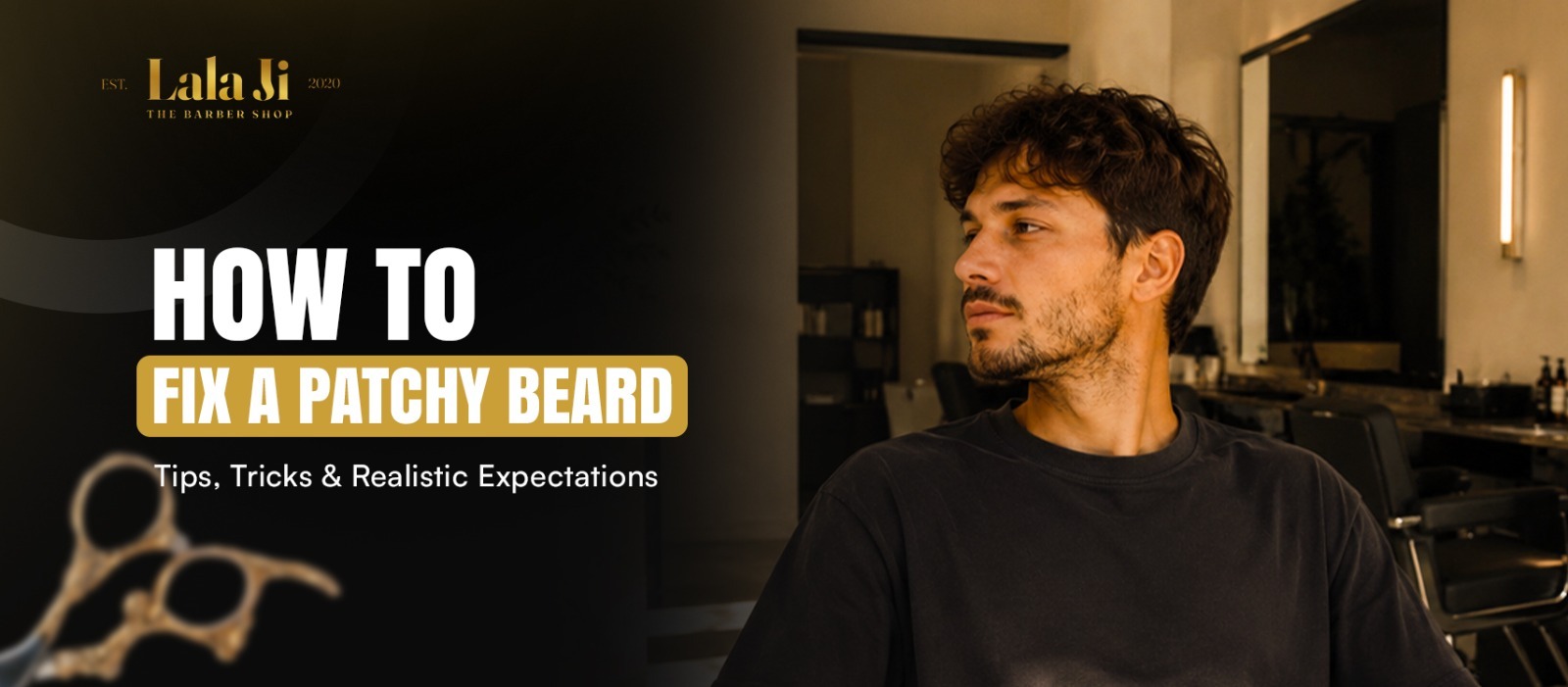
Let’s start with the conversation nobody wants to have. You’ve been growing your beard for six weeks, you’ve watched every YouTube video about “how to fix a patchy beard,” you’ve bought the beard oil and the boar bristle brush and the biotin supplements — and the patches are still there. Looking at you. Unmoved.

Here’s the thing: most of what the internet tells you about patchy beards is either wrong, oversimplified, or quietly trying to sell you something. At Lalaji The Barbershop — seven locations across Nova Scotia — we have this conversation in the chair almost every single day. So let’s have it properly.

By the end of this guide, you’ll understand exactly why patches happen, what you can realistically do about them, how to use beard architecture to make patches invisible, and — most importantly — why the first step is sitting in a barber’s chair rather than standing in front of your bathroom mirror with a trimmer.

Chapter One

Why Your Beard Is Patchy: The Honest Answer

Before you can fix something, you have to understand what’s actually happening. And the truth about patchy beards involves three factors — only one of which you have any meaningful control over.

1. Genetics — the non-negotiable

The primary reason most men have a patchy beard is the same reason some men are 6’2″ and some are 5’9″: genetics. Your beard growth pattern is determined by your androgen receptor sensitivity — specifically how your follicles respond to dihydrotestosterone (DHT), the hormone primarily responsible for facial hair growth. Men with high androgen sensitivity grow thick, full beards. Men with lower sensitivity, or with a genetic pattern of uneven follicle distribution, grow patchy ones.

This is not a medical problem. It’s not a testosterone deficiency. It’s not a sign of poor health. It’s inherited, the same way your eye colour is inherited. The sooner you make peace with this, the sooner you can focus on what you can actually change.

The DHT Supplement Trap

You’ve probably seen advertisements for beard growth supplements promising to “boost DHT” or “activate dormant follicles.” Here’s the clinical reality: if the follicle isn’t there, no supplement will create it. What these products can do is optimise conditions for existing follicles — but they cannot override your genetic growth pattern. Save your money for the barber.

2. Patience — the most underestimated factor

Here’s a fact that changes everything for most men: the vast majority of “patchy” beards at week three are not actually patchy at all. They’re simply unfinished. Facial hair grows at roughly half an inch per month, but follicles across your face don’t activate simultaneously — they grow in phases, on different schedules. The cheek hair might be two weeks behind the moustache. The chin might fill in a full month before the jaw line catches up.

Men give up on their beards between weeks three and six — precisely the phase when the gaps are most visible and the commitment feels most uncertain. If you’ve never grown your beard past six weeks, you genuinely don’t know what your beard looks like yet.

3. Blood Circulation — the one you can actually influence

Follicle health depends directly on blood flow to the skin. Better circulation means better nutrient delivery to active follicles, which means healthier hair growth from whatever follicles you do have. This is the legitimate, evidence-based mechanism behind the two things that actually make a difference in beard growth: regular facial massage and consistent exercise.

Two minutes of firm circular massage across your beard area every morning, combined with cardiovascular exercise that elevates your heart rate for 30+ minutes several times a week, genuinely improves the quality and rate of growth from existing follicles. Not dramatically. Not miraculously. But measurably, over time. This is the part you control. It’s humble and unglamorous and entirely true.

Chapter Two

Myths vs. Reality

The patchy beard space is full of noise. Let’s clear it with the myth-versus-reality breakdown that every man with a patchy beard deserves to read before spending a single dollar on solutions.

✕ The Myth

"Shaving more often makes your beard grow back thicker and fuller."

"Beard oils and serums will fill in my patches."

"A patchy beard means my testosterone is low."

"If I just let it grow, the patches will fill in."

"My beard is patchy, so I should just trim it all short and start over."

✓ The Reality
Shaving does nothing to follicle density. It only makes the blunt tip of regrowing hair feel stubbly. The thickness you perceive is an illusion. Your beard has the same number of follicles before and after every shave.
Beard oils condition and moisturise existing hair — they make what’s there look and feel better. They cannot stimulate follicles that aren’t active. Good oil is worth using. Miraculous claims about growth are not.
Beard density is about androgen receptor sensitivity, not testosterone levels. Many men with exceptionally full beards have average testosterone. Many men with low beard density have above-average testosterone. The two are not the same thing.
Sometimes — yes, genuinely. Many men discover at week eight or ten that what looked like permanent gaps were simply slow-growing areas. Patience, specifically past the six-week mark, is the single most underused beard tool in existence.
This resets your progress and restarts the awkward phase. The barber’s first visit is not a haircut — it’s an assessment. Trimming randomly at home before establishing the architecture almost always makes a patchy beard look worse, not better.